As
I wrote in two previous articles,
Sid Davis Productions contains the greatest collection of over-the-top, pushy,
and obnoxious short films aimed at the educational market. The main focus of most of the Sid Davis catalogue, besides driver safety films, were social conditioning films. Like the pathetic “abstinence-only”
& “teach men not to rape” brigades today , Davis felt it was up to the
state and underpaid civil servants to lead the way on this cause, as most
parents were too stupid to be able to do it properly. And similar to the infamous "Boys Beware" Davis
managed to do it with a heavy handedness that quickly becomes camp once its
viewers reach high school age.
So
here is a collection of five more of the most obnoxious educational scare films
ever made. Enjoy and Caveat Emptor:
Moment of Decision (1957): Heavy handed film about car stealing and joy riding.
Name Unknown (1952): For a thrill she traded her life in order to be a statistic.
The Dropout (1962): A warning to would be slackers. Stay in school or forever be branded a loser.
Control Your Emotions (1950): Remember feelings are for ethnic people.
Let's be Good Citizens At School (1953): This one seems to be exceptionally dated.
Here is a great old piece of British
Sci-Fi almost forgotten, and never really known in the States. It was the first
teleplay to connect the nature of ghosts with a sort of temporal static loop, a
recording from the past, rather than the spirits of the dead still roaming
about. For its time it was a rather fantastic concept.
This
was written by the great British Sci-Fi writer Nigel Kneale (whom we discussed
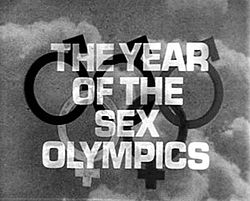
in an earlier post The Year of the Sex Olympics), known for bringing the first sci-fi drama to television in The Quatermass
Experiment, then for his TV adaptation of Orwell’s 1984 (starring a
young Peter Cushing and Donald Pleasance).
Kneale
was approached to write a play for the Christmas season and quickly that, in
keeping with Christmas tradition, he would write a ghost story, but with a
difference – ancient spirits would interplay with modern science. The concept
of mixing the supernatural with technology had been a feature of some of Kneale's
earlier work – most notably, his 1952 radio play You Must Listen, which
concerned a telecommunications engineer who discovers that a telephone line has
somehow preserved the final conversation between a woman and her lover before
her suicide.
Micheal Bryant in The Stone Tape
The story is as follows: Peter Brock
is the head of a research team attempting to develop a new recording medium.
The team moves into a an old Victorian mansion that has been renovated for
their use. After arriving, they discover that the overhaul of one of the rooms is
unfinished, the builders having refused to work in it because it is supposedly
haunted.
Jane Asher in The Stone Tape
The room, with its stone walls, is a remnant of the original building,
with foundations dating back to the Saxon era. Curious, the researchers explore
the room and hear the sounds of a woman running followed by a gut-wrenching
scream. Jill an emotionally sensitive computer programmer, has a vision of a
woman running up the steps in the room and falling to her death. Some research
uncovers that a young maid died in that room during Victorian times and that an
unsuccessful exorcism had previously been performed on the property.
Brock
hypothesises that it is not a ghost, but that somehow the stone in the room has
preserved an image of the girl's death—this "stone tape" may be the
new recording medium they have been seeking. Their scientific devices fail to
detect any evidence of the phenomena the team experience, and team members encounter
varied degrees of the phenomena: most are able to hear sounds, Jill can also
see images, but another member of the team experiences no sensory input. Jill suggests
that the "tape" does not produce actual sound or light, but instead
interfaces with the human nervous system to create the impressions sound and
vision, and some individuals are more sensitive to this than others. She
surmises that the recordings are imprinted in moments of extreme emotion, like
a kind of telepathy.
Excited
by the possibilities presented by a recording medium which uses a person's own
senses as the means of recording and playback, Brock and his team move into the
room. They bombard it with their technology, hoping to find the secret of the
"stone tape" and have it play on demand. When they repeatedly fail, a
last desperate attempt "wipes the recording" and some team members
break under the strain. Brock's failures are compounded when he is informed by
his superiors that the facility is to be shared with a rival research team
working on a new washing machine.
Embittered,
Brock no longer wants anything to do with the project. But after researching
the failed exorcism from the 1800s, Jill presents the theory that the stone
tape can be recorded over again and again and that the maid's death was simply
the most recent recording. Jill discovers that the maid's death was masking a
much older recording, left many thousands of years ago. Brock cruelly dismisses
her findings, and forces Jill to take a two-month leave to prevent her from
continuing her research.
Returning to the
room one last time, Jill's senses are besieged by a powerful, malevolent
presence from the much-degraded older recording. Like the maid before her, she
dies while frantically trying to escape it.
During
an inquest, Brock tries to save face by claiming that Jill was mentally
unstable. He then destroys all of her research without reading it. He makes a
final visit to the room and discovers to his horror that the stone tape has
made a new recording—that of Jill screaming his name as she dies.
The Stone Tape really is a
remarkable film and it has one of those rare endings that stay with you long
after viewing. It is a masterpiece of intelligent horror sci-fi. No jump scares
here, just a steady increase of tension which does not let up. Like the room
itself, the more exposure you have to The
Stone Tape the deeper your perception of the possibilities are.
During
the height of Soviet oppression, in Russia, where they were sending millions of
their own people and soldiers to the Gulag concentration camps (in the case of
the troopers it was usually for the crime of being captured by the enemy),
while simultaneously fighting the Nazis, an interesting person was captured by
some collective labor peasants. During the October of 1941, outside of Buinaksk
in what is modern day Dagestan, A Red Army lieutenant colonel by the name of V.
S. Karapetyan was summoned to inspect the prisoner, to determine whether he was
a spy, and if his strange appearance was a disguise.
His
official translated report (declassified in 1992 after the collapse of the Soviet
Union) reads as follows:
“I
can still see the creature as it stood before me, naked and bare-footed. And it
was doubtlessly a man, because its entire shape was human. The chest back, and
shoulders, however were covered with shaggy hair of a dark brown color….
“The
man stood absolutely straight with his arms hanging, and his height was above
average 180 centimeters [roughly six foot, above average for the people native
to this region]. He stood before me like a giant, his mighty chest thrust
forward. His fingers were thick, strong, and exceptionally large. On the whole,
he was considerably bigger than any of the local inhabitants. His eyes told me
nothing. They were dull and empty – the eyes of an animal…
“When
kept in a warm room he sweated profusely. While I was there, some water and
then some food was brought up to his mouth; and someone offered him a hand, but
there was no reaction. I gave the verbal conclusion that this was no disguised
person, but a wild creature of some kind.”
The
report then follows that while Karapetyan suggested that the creature be
returned to the wild, his superior, at the insistence of the political officer
attached to the unit, ordered it shot, in case it might be a spy. This also would allow the commander to claim a
victory, however hollow, to those who might accuse him of slackness and send him
off on a trumped up charge to one of the numerous death camps so popular in
Communist Russia. For more fun try books by Rex Hurst
This occurred in 1928 to a man named
Muchalat Harry, a Native American of the Nootka tribe, on Vancouver Island in
British Columbia. Harry was a trapper heading for the Conuma River to collect
some beaver pelts when he was attacked.
According to his report, one night he
found himself being scooped up and bundled in his own blankets by a large hairy
creature, roughly about 8 foot tall. He estimated that he had been carried two
to three miles. When he was dropped out of his blanket, he found himself
surrounded by close to twenty of the creatures, men, women and children. The
area seemed to be a makeshift campsite (no fire) littered with large bones. He
became terrified that the creatures were going to eat him.
But that didn’t happen. Instead they
seemed fascinated by this strange little man, so similar to themselves. A few
came forward pulling gently at his clothing, what they must have assumed was
his skin. To their amazement they found it loose. Several children also
nervously crept up and sniffed at him. All this time Harry remained motionless
and by late afternoon most of the tribe had grown bored with him and departed,
presumably to hunt or gather food.
Left by himself, Harry jumped up and
bolted for the woods. He admitted later that the creatures did not follow him,
but he was in a panic state and actually ran past his own camp, continuing on
for a dozen more miles until he reached his hidden canoe. He then paddled the
45 miles downriver to Nootka. He arrived there torn, nearly frozen, and uttering
wild cries.
He was eventually nursed back to
health, where he told his tale to some brothers in a nearby Benedictine mission
and gave up his profession of trapping. Rarely even stepping out his own
village.
Now
here is a truly unique film, brought to us by our French cousins and their
unique sensibilities. This is a film about Donatien Alphonse François, the Marquis de Sade done in an unusual style of puppetry,
live actors wearing animatronic masks, and some limited clay animation.
The
film was the brainchild of Roland Torpor who created the imagery and story
for the 1973 cult classic La Planète
Sauvage, or in English Fantastic
Planet. For those who remember it, the film was a wild ride of bizarre visual
and fascinating spiritual concepts, which took place on a distant planet where
Humans were bred as domesticated pets for a giant blue race of aliens. I will
do a full article on this at a later date.
Marquis
is a different take on life as if partially based on the philosophical writing
of de Sade. In pre-revolutionary France, the Marquis de Sade sits in the
Bastille working on his writing and having conversations with his penis named
Colin. When Colin is not whining about his need for stimulation and espousing
his impulsive philosophies, he is "telling stories" that make up the
Marquis' work. The symbolism is pretty thick here, but in tune with De Sade’s
writings, which were never subtle.
A close up of Colin
de Sade was imprisoned for shitting
on a cross. Additionally he is accused of raping and impregnating the bovine
Justine. The latter is a plot by a priest to try to keep secret the fact that
Justine's rapist was actually the King of France. These lead to some truly
weird sex scenes, including where the Marquis fucks a hole in a talking wall
with his penis; or where he has anal sex with a guard using a lobster; or of
the guard masturbating milk from the cow heroine’s udders.
Meanwhile, the revolutionaries
prepare to stage a coup and depose the king, under the lead of Juliette, an
equine noble. Several of the inmates are also political prisoners (including a
police chief imprisoned for selling bad pork) leading to several failed escape
attempts which land the inmates in the Bastille dungeon. They are eventually
freed, however, by the revolutionaries.
Colin eventually falls in love with
Juliette and runs away with her to continue the revolution, leaving the Marquis
to continue his writing and to muse about his life in peace.
Naturally this is not meant to be
taken in anyway as recreating of the Marquis de Sade’s life, but represents his
mental state and the state of France during his time in the Bastille. It is a
sympathetic look at de Sade. The film takes a Romantic position of a man of
intellect and letters warring with his sexual drive (and even has an end when
his penis takes off to find a life of its own).
In truth the Marquis de Sade had no
such conflict between mind and flesh. His work could not be regarded as
something pure and aside from his baser urges and were in fact fueled by his
urges to drive deeper into literary depravity. As is show in the fact that his
most savage work, The 120 Days of Sodom,
which was the basis for the film Salo (reviewed here)
was written in the Bastille.
This film is incredibly NSFW, but
should be experienced by anyone who want to watch something very different.
This is an interesting obscure little film originally made
for the Theater 625 program for the BBC in
1968, it had achieved some cult status for being ahead of its time narrative
and predicting the rise of reality TV some forty years before it became
dominant.
Nigel Kneale
It was written by veteran British Sci-Fi genius Nigel
Kneale known for bringing the first sci-fi drama to television in The Quatermass Experiment, then for his TV
adaptation of Orwell’s 1984 (starring
a young Peter Cushing and Donald Pleasance). He continued on with other
projects most notably, Quatermass 2, Quatermass
and the Pit, The Abominable Snowman, The Quatermass Conclusion, and The Stone Tape (which I will be covering
in a future article).
Originally filmed in glorious color, unfortunately that
version is lost and, except for a few stills, all we have is the black and
white copy. Still that is good enough. The drama takes place in a time "sooner than you think..."
when all the basic needs of the world have been met and successfully automated,
mankind has nothing to do with itself, leading to an overpopulation problem.
World peace had been achieved through the use of television
and “apathy control”. Society has been divided into two types of people, low
and high drives.
Future versions of you.
The low drives sit around
watching it all day and the leaders (high drives) realized that they can control
their behaviors by what they present on the tube. All of the redundant tendencies
of mankind (referred to as “tensions”)- love, war, hate, religion, loyalty,
family- are shown on the TV as a substitute for the real thing. Thus they have
the “Hungry Angry Show” to reduce those attributes and “The Sex Olympics”, “Sportsex”
and “Artsex” shows to allow people to leisurely masturbate over the beautiful
people and avoid the real thing, thus reducing the surplus population. As the
show puts it “gotta make ‘em think, ‘I cannot do that. Sex is not to do. Sex is
to watch.’”
Along with the limiting of thought on the small screen, the
language has also been culled to exclude such old time concepts from being
transmitted onto future generations. To aid this thus all children are raised separate
from their parents and marriage has been abolished.
Nat Mender, who has a bit of thyroid condition
The story revolves around Nat Mender, a television
producer, who is bored with his life and yearns for something that he cannot understand
or even conceive of. To top it off, the rating are lower as the populace has
become immured to the constant diet of sex and violence. Nat is contacted by
his ex-girlfriend Deanie about their child who is not doing well. The pair go
to visit the girl only to discover, to Nat’s horror, that she has been classified
as low drive and will be sent out to dwell with the unwashed masses. To top
this off Deanie’s new boyfriend, Lasar, is a moody artist type who wishes to
express himself in images of horror, but that would cause “tension” so it is
not allowed.
It is then determined that in order to get the audience
back interested humor has to be reintroduced into their programming lineup, but
all of their attempts to do so fail with a huge cringe factor. But then Lasar,
attempts to break into the Sex Olympics to show his horrible images and falls
off a rope killing himself. This unexpected accident sends the audience into peals
of laughter. Giving the studio heads a new idea.
Leonard Rossiter in Year of the Sex Olympics
Nat fed up with his life comes up with the “Live Life Show”
were he, Deanie, and their daughter are put on a deserted island to attempt to
survive in a stone age existence, having only a medieval type cottage provided
for them. He feels that this is something which could reconnect him to a spiritual
life that has been lost of modern society. All of this is broadcast 24/7 back
to the audience. But unknown to Nat, the producers also place a homicidal lunatic
on the island with them, because as they say “it’s a show, somethings gotta
happen.”
I won’t spoil the ending for you, but allow me to say that
no one I have ever shown this to has ever been disappointed. It is a truly “holy
shit” ending that will cause you to remember this fil for years to come.
The first known recording, outside of
the Bible, of foreign objects crashing down out of the heavens is in Livy’s History of Rome, (or Ab Urbe Condita
Libri, “Books Since the City's Founding to be precise) written about 10 CE.
In Book I Chapter XXXI he writes, “After
the defeat of the Sabines, when1 King Tullus and the entire Roman state were at
a high pitch of glory and prosperity, it was reported to the king and senators
that there had been a rain of stones on the Alban Mount. As this could scarce
be credited, envoys were dispatched to examine the prodigy, and in their sight
there fell from the sky, like hail-stones which the wind piles in drifts upon
the ground, a shower of pebbles.”
Further the Greek historian Athenaeus
refers to a three day fall of fish and frogs in the Deipnosophistae (Banquet of the Sophists), written around 200 CE.
Athenaeus writes, “I know also that
it has very often rained fishes. At all events, Phoenias, in the second book of
his Eresian Magistrates, says that in
the Chersonesus it once rained fish uninterruptedly for three days; and
Phylarchus, in his fourth book says that people had often seen it raining fish,
and often also raining wheat, and that the same thing has happened with respect
to frogs.”
Additionally Heracleides Lembus, an Egyptian
civil servant, historian, and philosophical writers, in the twenty-first book
of his History, written about 150 CE
states- "In Paeonia and Dardania it has, they say, before now rained
frogs; and so great has been the number of these frogs that the houses and the
roads have been full of them; and at first, for some days, the inhabitants,
endeavoring to kill them, and shutting up their houses, endured the pest; but
when they did no good, but found that all their vessels were filled with them,
and the frogs were found to be boiled up and roasted with everything they ate,
and when besides all this, they could not make use of any water, nor put their
feet on the ground for the heaps of frogs that were everywhere, and were
annoyed also by the smell of those that died, they fled the country." For more weirdness try Across the Wounded Galaxy by Rex Hurst
 As
I wrote in two previous articles,
Sid Davis Productions contains the greatest collection of over-the-top, pushy,
and obnoxious short films aimed at the educational market. The main focus of most of the Sid Davis catalogue, besides driver safety films, were social conditioning films. Like the pathetic “abstinence-only”
& “teach men not to rape” brigades today , Davis felt it was up to the
state and underpaid civil servants to lead the way on this cause, as most
parents were too stupid to be able to do it properly. And similar to the infamous "Boys Beware" Davis
managed to do it with a heavy handedness that quickly becomes camp once its
viewers reach high school age.