Showing posts with label Marquis de Sade. Show all posts

Saturday, August 13, 2016

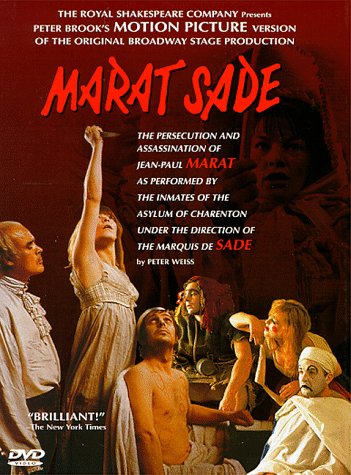
Marat/Sade: A Play About a Play About the Marquis de Sade


            The full title of this truly unique film is The Persecution and Assassination of Jean-Paul Marat as Performed by the Inmates of the Asylum of Charenton Under the Direction of the Marquis de Sade. For obvious reasons it tends to be shortened to Marat/Sade. This play is without a doubt one of the finest commentary on revolutionary politics and man’s inability to resolve the critical issues of our existence. It fully captures the unending struggle between the politics necessary to obtain freedom versus that which enslaves, and demonstrates how one could easily become the other.
Set in the historical Charenton Asylum, Marat/Sade is almost entirely a "play within a play". The main story takes place 15 years after the French Revolution, when de Sade was indeed committed to the insane asylum. It depicts the assassination of Jean-Paul Marat by Charlotte Corday.  The actors of the play within the play are all meant to be inmates of the asylum, with various nuns and guards around who occasionally step in to maintain order when the action gets out of hand. It is directed by de Sade himself, who take parts in it- offering up his philosophies and debating with Marat on the merits of his claims (or lack thereof) and revolution in general. It is overseen by the bourgeoisie director Abbé de Coulmier who occasionally steps in to object to some of the material presented in the play.

This is all based on actual events (though the substance of the play was entirely created by the author Peter Weiss. De Sade did perform plays with the inmates at the asylum at Charenton (now called Esquirol Hospital), encouraged by Coulmier- who viewed it as a form of therapy. Coulmier incidentally was widely praised for his new revolutionary ideas of asylum reform, as opposed to the old ways of just locking them up.
The Death of Marat (1793)
Jean-Paul Marat was one of the most radical voices of the French Revolution. His first political work, Chains of Slavery: A work in which the clandestine and villainous attempts of Princes to ruin Liberty are pointed out, and the dreadful scenes of Despotism disclosed was hailed and hated throughout France, depending on your social status. His other works contained many radical ideas, including the argument that society should provide basic needs such as food and shelter if it expected all its citizens to follow its laws, that the king was no more than the "first magistrate" of his people, that there should be a common death penalty regardless of class, and that each town should have a dedicated "avocat des pauvres" and set up independent criminal tribunals with twelve-man juries to ensure a fair trial.
During the revolution he started a newspaper championing it, after he continued attacking (and promoting violence against) those he considered too moderate or those he deemed counter-revolutionaries. Advising, "five or six hundred heads cut off would have assured your repose, freedom and happiness." During the turmoil that occurred after the execution of Louis XVI, Marat was arrested, acquitted, arrested again, acquitted again and the political landscape shifted from one dictator to the next. His life was eventually cut short by Charlotte Corday, who gained admittance to his home under false pretenses of having information on his political enemies. She stabbed him to death in his bath, where he spent much time due to a skin disease.
Donatien Alphonse François, the Marquis de Sade- from whose name the word sadism is coined- was a proponent of extreme freedom, unrestrained by morality, religion, or law. He was one of the seven prisoners freed when the Bastille was sacked by the crowd and numbered among the few aristocrats to survive the French Revolution. During his imprisonment in the jail he had been working on his magnum opus The 120 Days of Sodom (which was made into the film Salo). To his despair, he believed that the manuscript was lost during his transfer, but he continued to write. Indeed for a time he even thrived, acting as a judge, part of a hospital reform committee, and was elected to the National Convention as a member of the far left.
His works were, and still are, provocative to say the least. He often dealt in terms of sex, rape, and the abuse of power by the wealthy elite class. These were applauded by the founders of the revolution, then condemned by those same men after they took power, realizing that the vilification of the powerful now applied to them. He eventually was committed to Charlenton by Napoleon after the printing of Justine and Julliet- which were published anonymously. He stayed there until his death, apparently having an affair with the 14 year old daughter of an employee. After death his skull was removed from his grave for a phrenological examination. The bumps on his head showed nothing of interest.
The use of music in the film comments on themes and issues of the play. Unlike a traditional musical format, the songs do not further the plot or expositional development of character in the play. By contrast they often add an alienation effect, interrupting the action of the play and offering mocking historical, social and political commentary. Richard Peaslee composed music for the original English-language production of Marat/Sade directed by Peter Brook in the film below. There is no official score to the play in any language.
Marat/Sade is the best example of avant garde in the style known as “theater of cruelty” ever put on film. If you are looking for something truly different then you can do no better than this.
 The entire film is below. Enjoy and Caveat Emptor!


For more fun try Across the Wounded Galaxy by Rex Hurst


Saturday, February 13, 2016

Marquis- A Puppet Film about the Marquis de Sade


            Now here is a truly unique film, brought to us by our French cousins and their unique sensibilities. This is a film about Donatien Alphonse François, the  Marquis de Sade done in an unusual style of puppetry, live actors wearing animatronic masks, and some limited clay animation.

            The film was the brainchild of Roland Torpor who created the imagery and story for the 1973 cult classic La Planète Sauvage, or in English Fantastic Planet. For those who remember it, the film was a wild ride of bizarre visual and fascinating spiritual concepts, which took place on a distant planet where Humans were bred as domesticated pets for a giant blue race of aliens. I will do a full article on this at a later date.

            Marquis is a different take on life as if partially based on the philosophical writing of de Sade. In pre-revolutionary France, the Marquis de Sade sits in the Bastille working on his writing and having conversations with his penis named Colin. When Colin is not whining about his need for stimulation and espousing his impulsive philosophies, he is "telling stories" that make up the Marquis' work. The symbolism is pretty thick here, but in tune with De Sade’s writings, which were never subtle.

A close up of Colin
de Sade was imprisoned for shitting on a cross. Additionally he is accused of raping and impregnating the bovine Justine. The latter is a plot by a priest to try to keep secret the fact that Justine's rapist was actually the King of France. These lead to some truly weird sex scenes, including where the Marquis fucks a hole in a talking wall with his penis; or where he has anal sex with a guard using a lobster; or of the guard masturbating milk from the cow heroine’s udders.

Meanwhile, the revolutionaries prepare to stage a coup and depose the king, under the lead of Juliette, an equine noble. Several of the inmates are also political prisoners (including a police chief imprisoned for selling bad pork) leading to several failed escape attempts which land the inmates in the Bastille dungeon. They are eventually freed, however, by the revolutionaries.

Colin eventually falls in love with Juliette and runs away with her to continue the revolution, leaving the Marquis to continue his writing and to muse about his life in peace.

Naturally this is not meant to be taken in anyway as recreating of the Marquis de Sade’s life, but represents his mental state and the state of France during his time in the Bastille. It is a sympathetic look at de Sade. The film takes a Romantic position of a man of intellect and letters warring with his sexual drive (and even has an end when his penis takes off to find a life of its own).

In truth the Marquis de Sade had no such conflict between mind and flesh. His work could not be regarded as something pure and aside from his baser urges and were in fact fueled by his urges to drive deeper into literary depravity. As is show in the fact that his most savage work, The 120 Days of Sodom, which was the basis for the film Salo (reviewed here) was written in the Bastille.

This film is incredibly NSFW, but should be experienced by anyone who want to watch something very different.

Enjoy and Caveat Emptor!

                                                Full film is here.
For more weirdness try The Foot Doctor Letters: A Serial Killer Speaks Out by Rex Hurst. Available in paperback and on kindle. 

Thursday, March 26, 2015

Salo- The Film Which Gives You PTSD


            Salo is perhaps the vilest, most evil minded film ever made, that can still be considered an artistic achievement. Sure there are many violent gorefests out there, brimming with intensity, but Salo is a cut above these, earning the title “the most controversial film of all time.” It is a beautifully shot film of the most vile content imaginable.
            Salo is based upon The 120 Days of Sodom authored by Donatien Alphonse François, the Marquis de Sade, which he described as “the most impure tale that has ever been told since out world began.”  In it 4 Lords, a Duke, a Bishop, a Bank President, and a Judge- each representing a different pillar of society- kidnap 16 youths (8 boys and 8 girls) and take them to a fortress in the dead of winter from which they cannot escape. There with their guards, the Four Fuckers (men chosen for their enormous penises) and the Four Whores (old brothel keepers) the villain protagonists present themselves to the youths as their new Gods, their every whim to be considered law. They youths are told that they are objects to be used and discarded at the Lord’s will.
            The Whores each take turns telling stories from their experiences as a prostitute and madam, to incite the Lords and form an inspiration for the sexual abuse and torture of their captives. The stories begin with simple vices, and quickly move on to complex, criminal, and murderous ones, emulated by the Lords- eventually ending in the slaughter of their victims. And in the end, all fourwalk away unscathed, because they represent the law and power in the world.
            Strange as it may sound, de Sade novel's was attempting to make a political point here, not a sadistic pornographic one. Simple and direct (and perhaps overstated as is de Sade’s style) he demonstrates that the forces of government and power, who are supposed to prevent things like this from happening to, are the ones perpetuating the crimes. 
Only known portrait of de Sade

            For a historical context, we must remember that de Sade wrote this during the French Revolution, where the greed of the nobility had created one of the widest wealth gaps ever seen in Europe. By today’s standards France was a third world country. And the people, driven by desperation and a lack of the basic necessities of life, revolted. Wide spread revolution tending only to occur when they had no other viable option. For many revolutionaries it was literally fight or starve. Thus the events of the book fits very well into revolutionary ideology of the time.
            The 120 Days of Sodom is not actually a complete novel. While writing it de Sade was imprisoned in the Bastille, for crimes of sexual deviancy and for penning the novel Justine (another work detailing the rape of innocence by the ruling classes). He had completed only the first part and outlined the other three,when the Bastille was taken by revolutionary forces, freeing the Marquis and the other 4 inmates. Unfortunately for the Marquis this freedom meant a loss of a lot of his material, including his only copy of The 120 Days.
            The book had been written on a long continuous roll of paper, made up of small pieces of paper glued together and written in nearly microscopic text and hidden away from guards. De Sade had believed it lost in the post-battle looting of the Bastille, and it was not seen again until nearly a half century after his death, tucked away in its hiding place. But still the novel did not see publication until the second decade of the 20th century.
            Salo is the final film of Pier Paolo Passolini. He had finished his Trilogy of Life series (Deacameron, The Canterbury Tales, and Arabian Nights) and Salo was to be the first of his Trilogy of Death. Considering the unabashed cruelty in Salo one can only speculate what was going to happen in later films- consider Ilsa: She Wolf of the SS without the sex. Pasolini updated the setting, placing it during World War II in Salo, a town in northern Italy and made the four villain protagonists members of the fascist party. The town had a special place for Passolini as it was there that his brother was shot by the fascist government. But apart from these changes, he kept the flow and flavor of the book, picking and choosing which scenes of barbarity to display from the wide variety described by de Sade. Unflinchingly he kept the most grotesque scenes of rape, incest, blasphemy, sacrilege, torture, sodomy, and coprophagia.
Pier Paolo Passolini
            This was Pasolini’s last film because he was murdered shortly after he finished editing. Always a controversial figure, he was last seen alive walking down a beach with a male prostitute. His body was found two days later. The autopsy determined that a car had driven over his head at least twice, he had multiple fractured bones, and his genitals had been crushed by an iron bar (some reports claim they were severed and placed in his mouth), then the body was doused in gasoline and set ablaze. The prostitute was arrested and confessed, but as he was much weaker build than Passolini it has been a generally held belief that he was innocent. Other rumors suggest a mafia execution, leftover members of the Italian fascist party, or someone else upset with Passolini’s communist affiliations.  The truth will probably never be discovered. 
           Salo batters you, not with a continuous bombardment of images, but with a constant buildup of dread, a steady progression of evil, and the knowledge that it will get worse. There is no release from it. That dread is what cements everything in the mind. You cannot help but place yourself in the victim’s role and you find yourself asking, “What if that had been me?” Which is the cornerstone of the film, I never doubted that it could and might actually take place. A realistic horror film, which makes it all the worse.
And as the film progresses the dread increases.  We see the four villain protagonists take in more and more power, act to spit every social convention of society, and eventually spiral deeper into their own madness. The scene where feces is served up as a delicacy is perhaps the most nauseating thing I have ever viewed, up there with Divine’s dog shit eating scene in Pink Flamingos.
Eat up!

The film gives you PTSD. For days afterwards bits and pieces of it bob from your subconscious and slap you in the face. Weird things set it off- eating a bar of chocolate, seeing some art deco architecture, a mention of Italy or World War II. It is like a stain on your brain that you cannot scrub off. You cannot unring the bell. You cannot unsee the movie. Salo has such a large volume of vileness in such a short span of time that it is difficult to take in at first. Usually by the end you feel numb. Your brain needs time to process it all, hence the delayed effect.
 The Criterion Collection version contains a lot of behind the scenes footage and interviews and I was surprised ro see that the cast had a lot of fun making this film, both torturers and the tortured. Most of the actors were young, never having been in a film before, so there were many laughs and practical jokes being played.  And since it has filmed so disjointedly, most of the actors did not realize just how grim the final product would be.  
Viewer beware. Salo is a solid film, but earns it’s title of “the most controversial film of all time.” Criterion version is here.
 Trailer is below. Enjoy and Caveat Emptor