Saturday, September 26, 2015

The Yeren- The Chinese Bigfoot


     Nearly every culture has a variation on the Bigfoot legend, beginning with the character of Enkidu, the wild man of the woods, who is tamed by Gilgamesh and a holy prostitute.
      The Chinese variation on this legend is alternately called the 野人 –Yeren or Yeh Ren; 神农架野人-The Wildman; or人熊 The Monkey-Man. Most reports seemed to be focused around the mountains and forests in the province of Hubei in Central China. Descriptions of the creature place it as being smaller than its American or even Tibetan brethren.
Yeren Cave, Hubei Province, China
     Probably the best known tale of the Yeren occurred in 1957. During the morning of April 18th, as the local men were away at their labors, Xu Fudi, a young mother, heard a scream from the family barn. She rushed out and spotted her 6 year old daughter struggling in the grips of a naked humanoid creature. It was roughly about five foot tall, around 88 pounds, with white skin covered in dark brown hair, with a broad chest and sunken in nose. Apart from that, it appeared to me nearly human.
     Xu Fudi grabbed an axe handle and frantically beat on the creature. The sudden attack surprised it, and the yeren sprang into a paddy field to escape. Unfortunately for it, the creature became stuck in the mud, allowing the mother to catch up and continue walloping on it. By this time several other women from the village had arrived and joined in on the beating. Sustaining numerous head wounds, the creature fell over.  Assuming that it was dead, the women  turned to console the little girl when the creature recovered consciousness and started to whimper, tears running from its eyes. The women returned to finish the job, making sure that it was dead by snapping its neck and tearing it to pieces.
     Reportedly a biology teacher from a neighboring village took away the yeren’s hands and feet, carefully preserving them in formaldehyde. It was said that for weeks afterwards mournful grunts and howls could be heard echoing from the nearby hills.

 For more fun try books by Rex Hurst

Saturday, September 19, 2015

Infant Spontaneous Human Combustion


      We are all aware of the bizarre rumors of individuals randomly exploding into fire with no known scientific explanation- or no accepted scientific explanation. For the most part the victims of this occurrence have been alone and their ashes discovered later, along with a few leftover bits and pieces not consumed by the flames. The debate rages as to whether the cause has a biological explanation or if the people die due to some external interference. To add to the mystery there has been two cases, both in England, of spontaneous human combustion occurring in infants.
     In 1973 Parvindur Kaur, a 7 month old boy, and the carriage the baby was lying in burst into flames in the family’s living room, within full view of her mother, father, and two sisters. Initial attempts to extract the baby from the carriage were unsuccessful. The father received severe burns on his hands when he tried to pick up the child and ended up accidently dropping him back into the flames. While the younger daughter called for an ambulance, the other family members hurriedly brought in pots of water to douse the flames. They were able to pick up the baby after this and he was taken to the Burns Unit at Birmingham hospital. Despite the doctor’s best efforts, the child died the next day. An investigation found no cause for the fire, the focal point of it seemed centered around the child itself. The family blamed the carriage manufacturers and initiated a civil suit against them which was ultimately unsuccessful.
       The following year 6 month old, Samantha Bellows, also caught fire in her crib. Her parents woke one night, reacting to a wave of intense heat and found her crib ablaze. The crib was placed in the parent’s bedroom, it being a small flat. Later police found no evidence of forced entry in either the doors or windows, so it was doubtful that a stranger entered and started the fire. As the mother called for help, the father managed to rescue Samantha from the crib. As in the case above, he received severe burns, but managed to hold onto the child and rushed to the kitchen sink to cover her in water. The fire was extinguished but the baby died shortly thereafter. Both distraught parents were held for questioning, but ultimately were released due to lack of evidence of foul play.

 For more fun try books by Rex Hurst

Monday, September 14, 2015

Bigfoot Sightings Near Blood Mobiles


     In the otherwise peaceful area of Bath, New York a bizarre break-in occurred on the night of July 17th, 1973. The Red Cross had been collecting blood that day from volunteers at Haverly High, the local high school, but their vehicle experienced a mechanical failure, forcing the group to spend the night in town. The local market offered the workers the use of their freezers to store the collected blood in for the evening, while technicians and nurses stayed at a nearby Howard Johnson's.
   The next morning the store manager arrived at the market to find that the back door had been broken into. Police were called in and discovered that the only articles to have been molested was the containers of blood. Several dozen packets were missing, while the rest of the consignment were thrown about the freezer. The market’s back door had not been picked open, but was savagely beaten in, the handle smashed off with a blunt object. Police suspected this to be the work of teenagers.
    The area had been experiencing severe electrical storms for several weeks, quite out of season for the region, and one such storm had struck on that particular night. Several large tracks were found embedded in a field adjacent to the store. The police ignored them as unrelated to the case, but a towns person later made a plaster mold of one of them. The bare footprint was measured at an incredible 22 inches long and 7 inches wide.
An old chestnut
    This discovery is compounded with a phone call the police received the night of the break in. A local man, Albert Biggs, reported being threatened by a monster when he returned home from a bar. He described it as being at least 8 foot tall, hairy, and naked. The creature, according to Biggs, walked upright and wielded a large club. The monster yelled at Biggs (not in English) and waved its weapon in a threatening manner. Biggs ran into his house and the creature departed. Police dismissed the call as a wild tale from one of the town’s many alcoholics.
    No person was ever arrested in connection with the break-in and eventually the case was shelved. The Red Cross workers collected the remaining donations and left Bath the next day. They have since come back nearly every year, with no re-occurrence of trouble.
 For more fun try books by Rex Hurst

Saturday, September 5, 2015

Meet the Feebles- A Deranged Tribute to the Muppets


     With the upcoming release of The Happytime Murders, a puppet-noir murder mystery, and the first R-rated Muppet movie, I decided to look back on an old, but obscure, favorite- Meet the Feebles, directed by a young Peter Jackson (Lord of the Rings trilogy) before he was indoctrinated into the cult of CGI.
The Happytime Murders

     Yes, there once was a time when, Peter Jackson relied solely on practical effects rather than miring in the lazy water sof the digital animation quagmire. Meet the Feebles is his second film, wedged between the incredibly low budgeted Bad Taste (Available for viewing on Youtube) and the decently financed Dead Alive (also available).

      It is essentially a Muppet spoof (though Jackson claims otherwise), using many of the techniques employed by Henson Productions, such as the use of full body suits along with hand puppets manipulated by wires.

     The story is a behind the scenes look at a Muppet show equivalent called the Feeble Variety Hour. The cast is preparing for their big show and everything that could go wrong does. Jackson takes every negative stereotype about show business and plunks it in here.

    We see:

·        A rabbit who fucks like Charlie Sheen and gets an STD (referred to here as “the big one”). 

·         A Kermit the Frog analog who is a heroin addict and has Nam flashbacks.

·        An elephant who knocks up a chicken to make a bizarre looking baby and refuses to take responsibility for it.

·        A sleazy tabloid reporter that loves to wallow in shit.

·        The director is an effeminate fox who lovingly sings a song about sodomy.

·        A rat manager who makes disgusting pornos on the side (There’ nothing like watching a cow and a crab perform BDSM acts.) 

·        Blech the Walrus producer, a part time cocaine trafficker, who is married to the star but is having an affair with a feline chorus girl (Another great sex scene).

·        And finally we have the diva, Hiedi, a hippo married to Blech, who goes on a killing rampage with an M60 machinegun when she learns of his infidelities.
Not your standard Muppet protagonist
     This film certainly does show off Jackson’s talent as a filmmaker. You quickly forget that these are just dolls and see then as actual characters. There was one scene of a puppet chicken exploding from gunfire, which caused me to recoil from it gruesomeness. A puppet chicken! 
      All in all Meet the Feebles is a constant shock fest stamping mercilessly on all of your childhood Muppet memories and laughingly evilly the entire time. Apparently Jim Henson’s daughter was invited to the premier and stormed out 20 minutes in, while making a rant about how insulting it was to her father’s memory. Whether it is or it isn’t, Meet the Feebles is a unique movie. It’s gleefully vile, well shot with excellent voice acting, and over-the-top humor. It is highly recommended. And luckily the entire film is available on Youtube.


For more fun try Across the Wounded Galaxy by Rex Hurst


Saturday, August 29, 2015

You Don't Need to Wash the Whole Film Grey to be "Grim and Gritty"

 
Is there something there? I can't tell.
With the coming of Batman Vs. Superman I feel the need to address something that has been bothering me for some time. That is the use of “color code” for a film genre, or to be more precise the use of digital color correction to wash an entire film a specific tint. You may have noticed: Horror films are blue; Sci-fi is green; Films in the desert are yellow; And if it is supposed to be an apocalyptic film it will be grey. 
      The first to use this all the way through was O Brother Where Art Thou, who washed the film to give it that old time sepia color. Which was nice and different then. It worked for the style of film, but now the trend has got out of hand.
      The film which bothered me the most in its use of the color code was Man of Steel. The grey wash was so thorough that it nearly blotted out every other color and, even though there was a lot of action, the use of grey made everything very dull to watch. I saw it in Imax and 3-D and still I was so bored that I fell asleep. Later on, as I analyzed why I was so bored, the one thing that I hit on more than anything else was the color scheme. As much as this might make me sound like an idiot, the use of bright colors or a contrasting scheme helps to capture the viewer’s eye and hold their interest. When everything is monotone and gloomy, then a person’s attention lapses. If we look at babies, they are naturally attracted to bright shiny objects and colors. And we never really lose that interest, even as adults, we’ve just learned not to shove everything in our mouths.
       Man of Steel came out a while ago, but what really prompted me to write on this topic was a conversation I had with a drone not too long ago (How come so many of my blogs are spurred on this way?). And by drone, I mean some who laps up everything that is tossed at him and regurgitates it back without thought. It was as if I was speaking to a larynx rather than a brain. But I didn’t realize this when I first spoke to him, otherwise I wouldn’t have wasted my time.
       During our conversation it came out that he was a fan of Man of Steel. I described my problems with it and he shook his head. He stated that the film was supposed to be “grim and gritty” and that the color had to match. That everything being grey was necessary to set the tone of the film.
       “Otherwise people might not realize.” He added.
        The conversation soon became pointless and I gave up.  I will get into the whether the character of Superman needs to be “grim and gritty” on a future blog, but the idea that the entire film has to be a dull color to set the tone is ridiculous.
       To prove my point. I will contrast various scenes from that wonderful classic A Clockwork Orange against Man of Steel. No one in their right minds will ever say that the subject matter of A Clockwork Orange is anything but grim and gritty. It is a savage tale told with an unblinking eye, but damn is it colorful.


If your haven't read it.
It's real horrorshow.


Lets start with a scene of characters sitting down:
No wonder this planet committed suicide. It is the most depressing place in the Universe.
There is black here, but it is offset by many other colors and draws your eye in.


       Jungian psychologists have studied the effects of colors on people. They discovered that grey tends to make one feel of: dampness, depression, lack of confidence, lack of energy. Not a great mood for an action movie.
       How about another example? Here we have characters who are verbally opposing the scene's protagonist. Which has more energy?  
 I'm about to go into hibernation.

The color primarily used here is white. Even the graffiti on the wall is white.
Which stands out? Which is more vivid?
Now let’s take a look at the protagonists.
Superman
Alex Delarge
     Note that the Clockwork Orange is awash in brightness and light, and yet still is able to denote a sinister tone. That’s because before digital color correcting they used a device called acting to set the mood.
     But this is all people sitting around. Let’s look at some action! 
Flying around in dark clothes against a dark background.

Granted the giant penis helps to grab your attention as much as anything else.
     Had enough? Let’s just try one final image. This is reaction shot of the protagonist in peril. Which grabs your interest more?
Man of Steel...
or A Clockwork Orange?

      Unfortunately it does not seem like overuse of digital color correction is going away anytime soon. Like the shaky cam technique, a lot of film directors and producers seem convinced that it adds to a film’s quality- or at least is what people want.

       Why? Because at the end of the day a lot of people are going to want to see Batman and Superman fight, no matter what the film looks like.
 For more fun try books by Rex Hurst


Saturday, August 22, 2015

The Vanishing Prisoner


            There was a bizarre incident at the Prussian prison of Weischselmunde (near Danzig) circa 1815, involving the disappearance of a man named Diderici. He had worked as a valet for an important man in the city. After his employer died suddenly of a stroke, Diderici had dressed up in his master’s clothes and a white wig and attempted to withdraw a large sum of cash from the family’s bank while impersonating the dead man. He was caught almost immediately and sentenced to 10 year imprisonment.
            One afternoon he was walking in chains in the walled prison’s exercise yard, with other prisoners walking directly ahead and behind him when, as described by the other prisoners, he “began to fade.” According to testimony taken of both guards and convicts within seconds Diderici became intangible, then invisible. His iron chains clanking to the ground.
Prison at Weischselmunde
 Officials suspected that the guards had been bribed in some way to let Diderici escape, but when the inquiry into the disappearance only yielded 28 identical stories, the authorities had no choice but to label the incident as a bizarre “act of God” and closed the case. Diderici, who had somehow made reality every prisoner’s dream, was never heard from again.

 For more fun try books by Rex Hurst

Saturday, August 15, 2015

How Victor Hugo Created the Joker


            What’s this, you say? I proposed this as a blog entry to several people and each of them said the exact same thing. “The Joker? From Batman? You are out of your fucking mind.” And while it is true that Victor Hugo died in 1888 and the Joker did not appear in the pages of Batman until 1940, I still stand by my statement.
            Victor Hugo, that towering literary giant and author of two of the most notable novels to come out of the 19th Century – The Hunchback of Notre Dame and Les Miserables- published a melodramatic piece in 1869 titled L’Homme Qui Rit- translated as The Laughing Man or The Man Who Laughs. He wrote the story while living in the Channel Islands, having been exiled from France due to the political content of his other works.
            The action revolves around the character of Gwynplaine, a 25 year old sideshow worker in 17th Century England, whose face was mutilated in his early childhood into that of a clown’s mask- meaning his mouth was carved into a permanent grin. Unlike the Joker however, Gwynplaine is a sympathetic character. He lives with his friend Ursa, his pet wolf Homo (meaning “man” in Latin- stop your snickering) and a blind girl Dea, who is desperately in love with him.
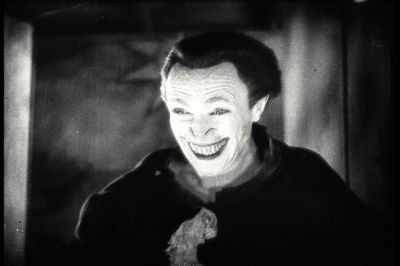
Conrad Veidt as Gwynplaine
Gwynplaine is eventually summoned to perform before the Queen of England for her court’s amusement and while there he stumbles across a doctor who is being tortured in the cells. It transpires that this same doctor is the same one who cut open Gwynplaine’s face as a child, on orders from the previous king. He then sold the boy to a group of travelers who used him to beg for alms. The reason for his disfigurement was that, after Gwynplaine’s parent had died, the previous king wished those estates to go to a supporter of his and decided to do away with the child.
            When the truth is eventually revealed, the new king reinstates Gwynplaine as a lord and provides him with a wife, who at first is sexually attracted to his freakish features, but soon completely rejects him. Upon his presentation to the House of Lords, Gwynplaine attempts to make a speech upon the unfairness of the modern age and the disparity between rich and poor, but he is laughed off the floor with much mocking of his features.
Realizing that he would never be accepted, Gwynplaine renounces his peerage and sets out to find his former family. He discovers that they had been exiled from England for illegally using a wolf in their act. He manages to board the ship they are on and he and Dea have a tender reunion before she suddenly dies of an unexplained illness. Gwnyplaine, driven to insanity and still speaking to Dea as if she were alive, walks off the side of the boat and into the icy water. It ends with Homo howling into the sea after his lost master.
            Eventually the book was made into the film The Man Who Laughs staring May Philbim as the blind Dea and Conrad Veidt as Gwynplaine (Veidt also acted as the Nazi general in Casablanca). He was decked out in a fairly decent looking set of dentures with metal hooks that pulled the corners of his mouth back into a very distinctive grin. Even though it is a silent film, it has a very modern feel and is beautifully shot. The late great Rodger Ebert described it as, “One of the final treasures of German silent expressionism… The Man Who Laughs is a melodrama, at times even a swashbuckler, but it is so steeped expressionist gloom that it plays like a horror film.”
Kino DVD cover
The movie plays more or less like the book, except at the end where the action is changed to Dea and Gwynplaine are happily reunited and sail off together. It was considered a lost film, until about 15 years ago when it was rediscovered, since then it has been restored by Kino (probably the best company around for silent film transfers) and distributed on DVD and Blue Ray.

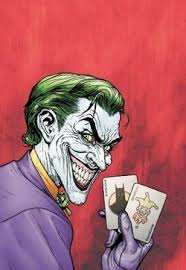
by  Doug Mahnke
            Most people who know their comic history will remember that the Joker’s creation is credited jointly to Jerry Robinson, Bill Finger, and Bob Kane (though Kane in his typical self-aggrandizement claims credit for the entire thing). The Joker debuted in Batman #1 and went on to appear in most of the first 12 issues. Now granted the characters of The Joker and Gwynplaine are light years apart, but Robinson claims that when he was tinkering around with the concept of the Joker, he originally based on a card from the playing deck, but felt it needed something more. Then he remembered The Man Who Laughs and added the smiling rictus to the characters face. Thus a classic was born from a classic.
          And that’s how Victor Hugo created the Joker.
For more weirdness try Across the Wounded Galaxy by Rex Hurst