Saturday, March 14, 2020

Third Public Examination of Joan of Arc - The Prophecies of Merlin


On Saturday February 24th, 1431, there opened in Rouen before a church tribunal chaired by Pierre Cauchon, the Bishop of Beauvais. It was a “trial in matters of faith” and one which that would lead Joan of Arc the stake on 30 May of the same year.

As we remember Joan was the fifteen year old divine “mad woman” who inspired the French to repel English invaders. She was captured during the siege of Compiègne in 1430. Her subsequent trial for heresy was the documented fully. Of no other trial in the 15th Century do we have a record as accurate and detailed. It is considered one of the most significant and moving trials ever conducted in human history.


In their presence We did require the forenamed Jeanne to swear to speak the truth simply and absolutely on the questions to be addressed to her, without adding any restriction to her oath. We did three times thus admonish her. She answered: “Give me leave to speak. By my faith! you may well ask me such things as I will not tell you. Perhaps on many of the things you may ask me I shall not tell you truly, especially on those that touch on my revelations; for you may constrain me to say things that I have sworn not to say; then I should be perjured, which you ought not to wish.”
[Addressing the Bishop:] “I tell you, take good heed of what you say, you, who are my Judge ; you take a great responsibility in thus charging me. I should say that it is enough to have sworn twice.”
“Will you swear, simply and absolutely?”
“You may surely do without this. I have sworn enough already twice. All the clergy of Rouen and Paris cannot condemn me if it be not law. Of my coming into France I will speak the truth willingly; but I will not say all: the space of eight days would not suffice.”
“Take the advice of the Assessors, whether you should swear or not.”
“Of my coming I will willingly speak truth, but not of the rest; speak no more of it to me.”
“You render yourself liable to suspicion in not being willing to swear to speak the truth absolutely.”
“Speak to me no more of it. Pass on.”
“We again require you to swear, precisely and absolutely.”
“I will say willingly what I know, and yet not all. I am come in God’s name; I have nothing to do here; let me be sent back to God, whence I came.”
“Again we summon and require you to swear, under pain of going forth charged with that which is imputed to you.”
“Pass on.”
“A last time we require you to swear, and urgently admonish you to speak the truth on all that concerns your trial; you expose yourself to a great peril by such a refusal.”
“I am ready to speak truth on what I know touching the trial.”
And in this manner was she sworn.
Then, by Our order, she was questioned by Maître Jean Beaupère, a well-known Doctor, as follows:
“How long is it since you have had food and drink?”
[This fasting suggests an attempt by the questioner to prove that her visions had a more or less physical cause in a weak bodily state resulting from abstinence. Her usual food consisted of a little bread dipped in wine and water, and as she is reported to have had when at home but one meal a day.]

“Since yesterday afternoon.”
“How long is it since you heard your Voices?”
“I heard them yesterday and today.”
“At what hour yesterday did you hear them?”
“Yesterday I heard them three times,-once in the morning, once at Vespers, and again when the Ave Maria rang in the evening. I have even heard them oftener than that.”
“What were you doing yesterday morning when the Voice came to you?”
“I was asleep: the Voice awoke me.”
“Was it by touching you on the arm?”
“It awoke me without touching me.”
“Was it in your room?”
“Not so far as I know, but in the Castle.”
“Did you thank it? and did you go on your knees?”
“I did thank it. I was sitting on the bed; I joined my hands; I implored its help. The Voice said to me: ‘Answer boldly.’ I asked advice as to how I should answer, begging it to entreat for this the counsel of the Lord. The Voice said to me: ‘Answer boldly; God will help thee.’ Before I had prayed it to give me counsel, it said to me several words I could not readily understand. After I was awake, it said to me : ‘Answer boldly.’ ”
[Addressing herself to Us, the said Bishop:] “You say you are my judge. Take care what you are doing; for in truth I am sent by God, and you place yourself in great danger.”
Maître Beaupère, continuing, said: “Has this Voice sometimes varied in its counsel?”
“I have never found it give two contrary opinions. . . . This night again I heard it say: ‘Answer boldly.'”
“Has your Voice forbidden you to say everything on what you are asked?”
“I will not answer you about that. I have revelations touching the King that I will not tell you.”
“Has it forbidden you to tell those revelations?”
“I have not been advised about these things. Give me a delay of fifteen days, and I will answer you. If my Voice has forbidden me, what would you say about it? Believe me, it is not men who have forbidden me. To-day I will not answer: I do not know if I ought, or not; it has not been revealed to me. But as firmly as I believe in the Christian Faith and that God has redeemed us from the pains of Hell, that Voice had come to me from God and by His Command.”
“The Voice that you say appears to you, does it come directly from an Angel, or directly from God; or does it come from one of the Saints?”
“The Voice comes to me from God; and I do not tell you all I know about it: I have far greater fear of doing wrong in saying to you things that would displease it, than I have of answering you. As to this question, I beg you to grant me delay.”
“Is it displeasing to God to speak the truth?”
“My Voices have entrusted to me certain things to tell to the King, not to you. This very night they told me many things for the welfare of my King, which I would he might know at once, even if I should drink no wine until Easter: the King would be the more joyful at his dinner!”
“Can you not so deal with your Voices that they will convey this news to your King?”
“I know not if the Voice would obey, and if it be God’s Will. If it please God, He will know how to reveal it to the King, and I shall be well content.”
“Why does not this Voice speak any more to your King, as it did when you were in his presence?”
“I do not know if it be the Will of God. Without the grace of God I should not know how to do anything.”
“Has your counsel revealed to you that you will escape from prison?”
“I have nothing to tell you about that.”
“This night, did your Voice give you counsel and advice as to what you should answer?”
“If it did give me advice and counsel thereon, I did not understand.”
“The last two occasions on which you have heard this Voice, did a light come with it ?”
“The light comes at the same time as the Voice.”
“Besides the Voice, do you see anything?”
“I will not tell you all; I have not leave; my oath does not touch on that. My Voice is good and to be honored. I am not bound to answer you about it. I request that the points on which I do not now answer may be given me in writing.”
“The Voice from whom you ask counsel, has it a face and eyes?”
“You shall not know yet. There is a saying among children, that ‘Sometimes one is hanged for speaking the truth.'”
“Do you know if you are in the grace of God?”
“If I am not, may God place me there; if I am, may God so keep me. I should be the saddest in all the world if I knew that I were not in the grace of God. But if I were in a state of sin, do you think the Voice would come to me? I would that everyone could hear the Voice as I hear it. I think I was about thirteen when it came to me for the first time.”
Shrine of Joan of Arc in Notre-Dame de Reims

“In your youth, did you play in the fields with the other children?”
“I certainly went sometimes, I do not know at what age.”
“Do the Domremy people side with the Burgundians or with the opposite party?”
“I knew only one Burgundian at Domremy: I should have been quite willing for them to cut off his head – always had it pleased God.”
“The Maxey people, were they Burgundians, or opposed to the Burgundians?”
“They were Burgundians. As soon as I knew that my Voices were for the King of France, I loved the Burgundians no more. The Burgundians will have war unless they do what they ought; I know it by my Voice. The English were already in France when my Voices began to come to me. I do not remember being with the children of Domremy when they went to fight against those of Maxey for the French side : but I certainly saw the Domremy children who had fought with those of Maxey coming back many times, wounded and bleeding.”
“Had you in your youth any intention of fighting the Burgundians?”
“I had a great will and desire that my King should have his own Kingdom.”
“When you had to come into France, did you wish to be a man?”
” I have answered this elsewhere.”
“Did you not take the animals to the fields?”
“I have already answered this also. When I was bigger and had come to years of discretion, I did not look after them generally; but I helped to take them to the meadows and to a Castle called the Island, for fear of the soldiers. I do not remember if I led them in my childhood or not.”
“What have you to say about a certain tree which is near to your village ?”
“Not far from Domremy there is a tree that they call ‘The Ladies’ Tree ‘-others call it ‘The Fairies’ Tree’; near by, there is a spring where people sick of the fever come to drink, as I have heard, and to seek water to restore their health. I have seen them myself come thus; but I do not know if they were healed. I have heard that the sick, once cured, come to this tree to walk about. It is a beautiful tree, a beech, from which comes the ‘beau may.’ It belongs to the Seigneur Pierre de Bourlement, Knight. I have sometimes been to play with the young girls, to make garlands for Our Lady of Domremy. Often I have heard the old folk – they are not of my lineage – say that the fairies haunt this tree. I have also heard one of my Godmothers, named Jeanne, wife of the Marie Aubery of Domremy, say that she has seen fairies there; whether it be true, I do not know. As for me, I never saw them that I know of. If I saw them anywhere else, I do not know. I have seen the young girls putting garlands on the branches of this tree, and I myself have sometimes put them there with my companions; sometimes we took these garlands away, sometimes we left them. Ever since I knew that it was necessary for me to come into France, I have given myself up as little as possible to these games and distractions. Since I was grown up, I do not remember to have danced there. I may have danced there formerly, with the other children. I have sung there more than danced. There is also a wood called the Oak-wood, which can be seen from my father’s door; it is not more than half-a-league away. I do not know, and have never heard if the fairies appear there; but my brother told me that it is said in the neighborhood: ‘Jeannette received her mission at the Fairies’ Tree.’ It is not the case; and I told him the contrary. When I came before the King, several people asked me if there were not in my country a wood, called the Oak-wood, because there were prophecies which said that from the neighborhood of this wood would come a maid who should do marvelous things. I put no faith in that.”
[Merlin had foretold the coming of a maiden out of an oak-wood from Lorraine; and a paper containing a prophecy to this effect had been sent, at the beginning of Joan’s career, to the English Commander, the Earl of Suffolk. There was also an old prophecy (quoted by Joan herself to Catherine Leroyer) that France, which had been “lost by a woman, should be saved by a Maid.” The conduct of Isabeau of Bavaria, wife of Charles VI, might certainly be said to have fulfilled the first half of this prophecy; and a tradition in the eastern counties that “deliverance should come from a maid of the Marches of Lorraine” must have directed many hopes to the mission of the Maiden from Domremy, though she herself does not seem to have known of the last prediction until sometime later. The oak-wood covers the hills above Domremy to this day.]  
“Would you like to have a woman’s dress?”
“Give me one, and I will take it and begone; otherwise, no. I am content with what I have, since it pleases God that I wear it.”
This done, We stayed the interrogation, and put off the remainder to Tuesday next, on which day We have convoked all the Assessors, at the same place and hour.
For more readings, try books by Rex Hurst. 


Saturday, February 29, 2020

Second Examination of Joan of Arc- Describes Her Religious Visions


On January 9, 1431, there opened in Rouen before a church tribunal chaired by Pierre Cauchon, the Bishop of Beauvais. It was a “trial in matters of faith” and one which that would lead Joan of Arc the stake on 30 May of the same year.

As we remember Joan was the fifteen year old divine “mad woman” who inspired the French to repel English invaders. She was captured during the siege of Compiègne in 1430. Her subsequent trial for heresy was the documented fully. Of no other trial in the 15th Century do we have a record as accurate and detailed. It is considered one of the most significant and moving trials ever conducted in human history.


SECOND PUBLIC EXAMINATION

Thursday, February 22nd, in the Ornament Room at the end of the Great Hall of the Castle of Rouen.
The Bishop and 48 Assessors Present.
In their presence, We showed that Jean Lemaître, Deputy of the Chief Inquisitor, had been summoned and required by Us to join himself to the present Action, with Our offer of communicating to him all that had been done hitherto or shall be done in the future; but that the said Deputy had replied, that, having been commissioned by the Chief Inquisitor for the City and Diocese of Rouen only, and the actual Process being deduced by Us in a territory which had been ceded to Us by the Metropolitan Chapter, by reason of Our Ordinary Jurisdiction as Bishop of Beauvais, he had thought it right to avoid all nullity and also for the peace of his own conscience, to refuse to join himself with Us, in the quality of Judge, until he should receive from the Chief Inquisitor a Commission and more extended powers: that, nevertheless, he would have no objection to see the trial continue without interruption.
After having heard Us make this narration, the said Deputy, being present, declared, addressing himself to Us, “That which you have just said is true. It has been, as far as in me lies, and still is, agreeable to me that you should continue the Trial.”
Then the said Jeanne was brought before Us.
We warned and required her, on pain of law, to make oath as she had done the day before and to swear simply and absolutely to speak truth on all things in respect of which she should be questioned; to which she answered:
“I swore yesterday: that should be enough.”
Again We required her to swear: we said to her, not even a prince, required to swear in a matter of faith, can refuse.
“I made oath to you yesterday,” she answered, “that should be quite enough for you: you overburden me too much!”
Finally she made oath to speak truth on ‘that which touches the Faith.’
Then Maitre Jean Beaupère, a well-known Professor of Theology, did, by Our order, question the said Jeanne. This he did as follows:
“First of all, I exhort you, as you have so sworn, to tell the truth on what I am about to ask you.”
“You may well ask me some things on which I shall tell you the truth and some on which I shall not tell it you. If you were well informed about me, you would wish to have me out of your hands. I have done nothing except by revelation.”
“How old were you when you left your father’s house?”
“On the subject of my age I cannot vouch.”
“In your youth, did you learn any trade?”
“Yes, I learnt to spin and to sew; in sewing and spinning I fear no woman in Rouen. For dread of the Burgundians, I left my father’s house and went to the town of Neufchateau, in Lorraine, to the house of a woman named La Rousse, where I sojourned about fifteen days. When I was at home with my father, I employed myself with the ordinary cares of the house. I did not go to the fields with the sheep and the other animals. Every year I confessed myself to my own Cure, and, when he was prevented, to another Priest with his permission. Sometimes, also, two or three times, I confessed to the Mendicant Friars; this was at Neufchateau. At Easter I received the Sacrament of the Eucharist.”

“Have you received the Sacrament of the Eucharist at any other Feast but Easter?”
“Pass that by [Passez outré]. I was thirteen when I had a Voice from God for my help and guidance. The first time that I heard this Voice, I was very much frightened; it was mid-day, in the summer, in my father’s garden. I had not fasted the day before. I heard this Voice to my right, towards the Church; rarely do I hear it without its being accompanied also by a light. This light comes from the same side as the Voice. Generally it is a great light. Since I came into France I have often heard this Voice.”
“But how could you see this light that you speak of, when the light was at the side?”
To this question she answered nothing, but went on to something else. ” If I were in a wood, I could easily hear the Voice which came to me. It seemed to me to come from lips I should reverence. I believe it was sent me from God. When I heard it for the third time, I recognized that it was the Voice of an Angel. This Voice has always guarded me well, and I have always understood it; it instructed me to be good and to go often to Church; it told me it was necessary for me to come into France. You ask me under what form this Voice appeared to me? You will hear no more of it from me this time. It said to me two or three times a week: ‘You must go into France.’ My father knew nothing of my going. The Voice said to me: ‘Go into France!’ I could stay no longer. It said to me: ‘Go, raise the siege which is being made before the City of Orleans. Go!’ it added, ‘to Robert de Baudricourt, Captain of Vaucouleurs: he will furnish you with an escort to accompany you.’ And I replied that I was but a poor girl, who knew nothing of riding or fighting. I went to my uncle and said that I wished to stay near him for a time. I remained there eight days. I said to him, ‘I must go to Vaucouleurs.’ He took me there. When I arrived, I recognized Robert de Baudricourt, although I had never seen him. I knew him, thanks to my Voice, which made me recognize him. I said to Robert, ‘I must go into France!’ Twice Robert refused to hear me, and repulsed me. The third time, he received me, and furnished me with men; the Voice had told me it would be thus. The Duke of Lorraine gave orders that I should be taken to him. I went there. I told him that I wished to go into France. The Duke asked me questions about his health; but I said of that I knew nothing. I spoke to him little of my journey. I told him he was to send his son with me, together with some people to conduct me to France, and that I would pray to God for his health. I had gone to him with a safe-conduct: from thence I returned to Vaucouleurs. From Vaucouleurs I departed, dressed as a man, armed with a sword given me by Robert de Baudricourt, but without other arms. I had with me a Knight, a Squire, and four servants, with whom I reached the town of Saint Urbain, where I slept in an Abbey. On the way, I passed through Auxerre, where I heard Mass in the principal Church. Thenceforward I often heard my Voices.”
“Who counseled you to take a man’s dress?”
To this question she several times refused to answer. “In the end, she said: “With that I charge no one.”
Many times she varied in her answers to this question. Then she said:
“Robert de Baudricourt made those who went with me swear to conduct me well and safely. ‘Go,’ said Robert de Baudricourt to me, ‘Go! and let come what may!’ I know well that God loves the Duke d’Orleans; I have had more revelations about the Duke d’Orleans than about any man alive, except my King. It was necessary for me to change my woman’s garments for a man’s dress. My counsel thereon said well.
“I sent a letter to the English before Orleans, to make them leave, as may be seen in a copy of my letter which has been read to me in this City of Rouen; there are, nevertheless, two or three words in this copy which were not in my letter. Thus, ‘Surrender to the Maid,’ should be replaced by ‘Surrender to the King.’ The words, ‘body for body’ and ‘chieftain in war’ were not in my letter at all.
“I went without hindrance to the King. Having arrived at the village of Saint Catherine de Fierbois, I sent for the first time to the Castle of Chinon, where the King was. I got there towards mid-day, and lodged first at an inn. After dinner, I went to the King, who was at the Castle. When I entered the room where he was I recognized him among many others by the counsel of my Voice, which revealed him to me. I told him that I wished to go and make war on the English.”

“When the Voice showed you the King, was there any light?”
“Pass on.”
“Did you see an Angel over the King?”
“Spare me. Pass on. Before the King set me to work, he had many apparitions and beautiful revelations.”
“What revelations and apparitions had the King?”
“I will not tell you; it is not yet time to answer you about them; but send to the King, and he will tell you. The Voice had promised me that, as soon I came to the King, he would receive me. Those of my party knew well that the Voice had been sent me from God; they have seen and known this Voice, I am sure of it. My King and many others have also heard and seen the Voices which came to me: there were there Charles de Bourbon and two or three others. There is not a day when I do not hear this Voice; and I have much need of it. But never have I asked of it any recompense but the salvation of my soul. The Voice told me to remain at Saint-Denis, in France; I wished to do so, but, against my will, the Lords made me leave. If I had not been wounded, I should never have left. After having quitted Saint-Denis, I was wounded in the trenches before Paris; but I was cured in five days. It is true that I caused an assault to be made before Paris.”
“Was it a Festival that day?”
“I think it was certainly a Festival.”
“Is it a good thing to make an assault on a Festival?”
“Pass on.”
And as it appeared that enough had been done for today, We have postponed the affair to Saturday next, at 8 o’clock in the morning.
For more readings, try books by Rex Hurst. 

Saturday, February 22, 2020

First Examination of Joan of Arc


On January 9, 1431, there opened in Rouen before a church tribunal chaired by Pierre Cauchon, the Bishop of Beauvais. It was a “trial in matters of faith” and one which that would lead Joan of Arc the stake on 30 May of the same year.
As we remember Joan was the fifteen year old divine “mad woman” who inspired the French to repel English invaders. She was captured during the siege of Compiègne in 1430. Her subsequent trial for heresy was the documented fully. Of no other trial in the 15th Century do we have a record as accurate and detailed. It is considered one of the most significant and moving trials ever conducted in human history.

FIRST PUBLIC EXAMINATION
On Wednesday, February 21st, at 8 o’clock in the morning, in the Chapel Royal of the Castle of Rouen.
The Bishop and 42 Assessors Present.
We did first of all command to be read the Royal letters Conveying surrender and deliverance of the said woman into Our hands; afterwards the letters of the Chapter of Rouen, making concession of territory for Our benefit. This reading ended, Master Jean d’Estivet, nominated by Us as Promoter of the Case, did, in Our presence, show that the aforesaid woman of the name of Jeanne had been, by the Executor of Our Mandate, cited to appear in this place at this hour and day, here to answer, according to law, to the questions to be put to her.
The said Promoter did then produce Our Mandate, to which is attached the document confirming its execution, and did read them all. Our said Promoter did then require that the said woman should be placed before us, and, in terms of the citation, questioned by Us on divers Articles concerning the Faith, to the which We did agree. But as a preliminary, because the said woman had asked to hear Mass beforehand, We did show to the Assessors that, by the advice of well-known Doctors and Masters consulted by Us, it had been decided, considering the crimes of which she is accused and the impropriety of the dress which she is wearing, that it is right to postpone permission to hear Mass and to assist in Divine Service.
In the meantime, the said woman was brought by the Executor of Our Mandate, and set before Us.
We did then saw that the said Jeanne had been lately taken in the territory of Beauvais ; that many acts contrary to the Orthodox Faith have been committed by her, not only in Our Diocese, but in many others; that the public report, which imputes these misdeeds to her, had spread in all estates of Christendom; that, in the last place, the most Serene and most Christian our lord the King had sent and given her up to Us in order that, according to law and right, an action may be brought against her in the matter of the Faith; that, acting upon this common report, upon public rumor, and also on certain information obtained by Us, of which mention had already been often enough made, by the advice of men versed in sacred and secular Law, We have officially given commandment to cite the said Jeanne to appear before Us, in order through her to obtain truthful answers to the questions to be put to her in matters of the Faith, and in order to act towards her according to law and right; which do so appear in the letters that the Promoter has shown.
Then, desiring in this, particular the blessed succor of Jesus Christ, Who is concerned in this, and wishing only to fulfill the duties of Our office for the exaltation and preservation of the Catholic Faith, We did first charitably warn and require the said Jeanne, seated in Our presence, for the more prompt resolution of the Action and the relief of her own conscience, to speak the whole truth upon all questions which should be addressed to her touching the Faith; and We did exhort her to avoid all subterfuges and falsehoods of such a nature as should turn her aside from a sincere and true avowal.
And in the first instance we did require her, in the appointed form, her hand on the Holy Gospels, to swear to speak truth on the questions to be addressed to her.
To which she did reply:
“I know not upon what you wish to question me; perhaps you may ask me of things which I ought not to tell you.”
“Swear,” We did then say to her, “to speak truth on the things which shall be asked you concerning the Faith, and of which you know.”
“Of my father and my mother and of what I did after taking the road to France, willingly will I swear; but of the revelations which have come to me from God, to no one will I speak or reveal them, save only to Charles my King; and to you I will not reveal them, even if it cost me my head; because I have received them in visions and by secret counsel, and am forbidden to reveal them. Before eight days are gone, I shall know if I may reveal them to you.”
Again did We several times warn and require her to be willing, on whatsoever should touch on the Faith, to swear to speak truly. And the said Jeanne, on her knees, her two hands resting on the Missal, did swear to speak truth on that which should be asked her and which she knew in the matter of the Faith, keeping silence under the condition above stated, that is to say, neither to tell nor to communicate to any one the revelations made to her.

After this oath, Jeanne was interrogated by Us as to her name, and surname, her place of birth, the names of her father and mother, the place of her baptism, her godfathers and godmothers, the Priest who baptized her, etc.
“In my own country they call me Jeannette; since I came into France I have been called Jeanne. Of my surname I know nothing. I was born in the village of Domremy, which is really one with the village of Greux. The principal Church is at Greux. My father is called Jacques d’Arc ; my mother, Ysabelle. I was baptized in the village of Domremy [The Font and Holy water stoup in the old Church at Domremy are 15th century, and to have been used at Jeanne’s baptism.] One of my godmothers is called Agnes, another Jeanne, a third Sibyl. One of my godfathers is called Jean Lingué another Jean Barrey. I had many other godmothers, or so I have heard from my mother. I was, I believe, baptized by Messier Jean Minet; he still lives, so far as I know. I am, I should say, about nineteen years of age. From my mother I learned my Pater, my Ave Maria, and my Credo. I believe I learned all this from my mother.”
“Say your Pater.”
“Hear me in confession, and I will say it willingly.”
To this same question, which was many times put to her, she always answered: “No, I will not say my Pater to you, unless you will hear me in confession.”
“Willingly,” We said to her, “We will give you two well-known men, of the French language, and before them you shall say your Pater.”
“I will not say it to them, unless it be in confession.”
And then did We forbid Jeanne, without Our permission, to leave the prison which had been assigned to her in the Castle, under pain of the crime of heresy.
“I do not accept such a prohibition,” she answered; “if ever I do escape, no one shall reproach me with having broken or violated my faith, not having given my word to any one, whosoever it may be.”
And as she complained that she had been fastened with chains and fetters of iron, We said to her:
“You have before, and many times, sought, We are told, to get out of the prison, where you are detained; and it is to keep you, more surely that it has been ordered to put you in irons.”
“It is true I wished to escape; and so I wish still; is not this lawful for all prisoners?”
We then commissioned as her guard the noble man John Gris, [John Gris, or Grey, a gentleman in the Household of the Duke of Bedford, afterwards knighted. He was appointed chief guardian to the Maid, with two assistants, all members of the King’s Body Guard. They appear to have left her entirely in the hands of the common soldiers, five of whom kept constant watch over her.] Squire, one of the Body Guard of our Lord the King, and, with him, John Berwoit and William Talbot, whom We enjoined well and faithfully to guard the said Jeanne, and to permit no person to have dealings with her without Our order. Which the forenamed, with their hands on the Gospels, did solemnly swear.
Finally, having accomplished all the preceding, We appointed the said Jeanne to appear the next day, at 8 o’clock in the morning, before Us in the Ornament Room, at the end of the Great Hall of the Castle of Rouen.

For more readings, try books by Rex Hurst. 

Saturday, February 8, 2020

Write On: The Podcast for Aspiring Writers.


A year or so has gone by for the Write On SC radio show and we’ve had a number of good ones. If you’re interested in the art of writing or supporting us you can catch us on Patreon
But do me a favor, if you’re a writer or are interested in becoming one, take a look at the titles, see if any interest you and then listen. Enjoy.


Gratitude, Holidays, & Rivals
EPISODE SUMMARY
Writers are some of the luckiest people around. Just think of it: we get to call “reading” work; we get to tell stories that get people emotional, excited, and thrilled; we get to create characters and live with them all the time. What other things do writers have to be grateful for?

Beam me up, Scotty! Pop culture references in literature
EPISODE SUMMARY
Last week between segments we ended up talking about whether you should use pop culture references in your work. There’s a slew of reasons not to and we’ll get into that. But suffice it to say that most MFA programs and literary types will tell you a pop culture reference dates your work and may not be relatable for all readers. So using them is risky at best and against the rules at worst.

Pace 911 or Why You're Bored With a Story You Wanted to Love
EPISODE SUMMARY
“Pace” is one of those mysterious writerly words that when we use it in critique the newbie’s eyes glaze over. Pace in literature is the speed at which the story is told. How fast the action moves, how quickly the characters achieve their goals, not necessarily the time over which the story takes place, but the urgency of the action that makes up the story.

Pre-Writing and NaNoWriMo
EPISODE SUMMARY
In the beginning, telling the story is about you, the writer, getting the story on the page. We know eventually you have to go to marketing the thing to the reader, but let’s be honest. If you were writing with the reader in mind you may not be committed enough to finish the project.

The Importance of Feedback
EPISODE SUMMARY
If you’re not testing your work on readers — actual real people who aren’t related to you — then you’re flying blind. You have GOT to get some folks to look over your work before you hit “publish” on Amazon. Please. For all of us.

Saturday, January 25, 2020

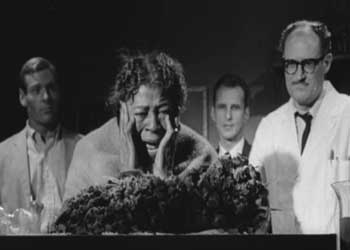
Celebrating Black Actress Eulabelle Moore- Obscure, But Not Forgotten


If you haven’t heard her name before, don’t be ashamed. Eulabelle Moore has only four IMDB credits to her name, not one of them big name productions.  In fact, like Eulabelle you’ve probably never heard of. The first is an uncredited role (probably a servant) in the 1951 low-budget melodrama Teresa about a soldier in WWII who marries a small town girl in Italy and tries to transition back to the U.S. Next is The Elgin Hour from 1955, a play-of-the-week-type of live drama broadcast. She receives a credited role in some forgettable play called Mind Over Momma, the plot of which has disappeared into the void of history. Thirdly, she had a small part in the failed police drama Brenner in 1959 about a hardened cop being forced to partner up with his own idealistic rookie son.  
And finally, the film I know her from, The Horror of Party Beach, an obscure low-budget 1964 production which attempted to combine the newly popular teen beach films with the also popular horror genre. I am only aware of this film because I was an avid viewer of Mystery Science Theater 3000 which did it classic style in 1997. That particular episode is located in full below and it is hysterical. Give it a look, if only to see Eulabelle, who sadly passed away shortly after this film was released.
I can’t tell you much more about her, but while perusing reviews of The Horror of Party Beach on the International Movie Database – something I often do when my wife is talking at me – I discovered this tribute to the actress posted by robert-temple-1 which I found very interesting. I have no reason to doubt the accuracy of information here, so I will reprint the entire review about Eulabelle Moore in full. Enjoy and Caveat Emptor.

“Why on earth would I review a film as worthless and ridiculous as this one? There is only one reason. It is because it was the only feature film in which my old friend Eulabelle Moore appeared, and I want to put on record on the database a few facts about her, and give her a tribute. It is now 45 years since Eulabelle died, and I must be one of the last people left alive who knew her. I was a teenager at the time. Eulabelle and I spent many, many hours talking together, and there was a time long ago when I could have related the entire story of her life. As I seem to recall, she had come up from the South to New York during the Depression, where she tried to start a new life. She never married and had no children, and was pretty much a loner, despite having many fond friends and acquaintances, as she was extremely gregarious when in company, but she was naturally a solitary person.
She got into acting late in life, and appeared in her first Broadway play at the age of 33. In those days of segregation, she tended to be type-cast as the black maid, which after all were often the only parts available for black women on the stage. She soon became a favourite character actress on Broadway and was frequently described as the Hattie McDaniel of New York. Everyone who has ever seen 'Gone with the Wind' remembers Hattie McDaniel, who went on to appear in film after film with her wonderful sense of humour, colourful language, and no-nonsense approach to keeping her 'white folks' in order and under control whilst pretending to be their servant. Eulabelle never played things with as broad strokes as Hattie, but was far more subtle and sophisticated. I believe they met a couple of times but were not friends. I suspect that Hattie was no great brain, but Eulabelle was extraordinarily intelligent and sophisticated in her way.
In our endless conversations late into the night, she always spoke with such compelling intelligence and insight that it was a joy to learn the lessons of life from her morality tales. She carried her skillet (old iron frying-pan) with her everywhere she went, along with a miniature portable stove and pan to boil her vegetables in. She was an expert at survival by cooking for herself in boarding house rooms. One of the reasons she and I 'bonded' was that I have always been as attached to my skillet as she was to hers, since the one from which I have had my fried bacon and eggs for breakfast all my life goes back to the 17th century and was used by my Leonard ancestors almost daily since they made it in their own iron works, the first in America, at Taunton, Massachusetts. It has been in continuous use in the family for over 300 years, and looks it! (Isn't it strange, the objects which survive?) Eulabelle loved hearing about my skillet, and having skillets in common really meant something to us. It also meant a lot to her that it was my grandmother who started the American craze for black-eyed peas, which Eulabelle loved. Eulabelle was an expert at cooking her soul food, but I did teach her one trick, how to cook barley as rice. She and I had many a feast on it, she raved about it, and she couldn't have been more thrilled at this 'new soul food' which I had recommended to her and which 'even we black folks down South had never heard of nor thought of eating like that, but I wish we had'.

On Broadway, Eulabelle had been directed by Elia Kazan twice, Otto Preminger, Robert Rossen, and George Abbott. She had appeared in plays by Thornton Wilder, Moss and Hart, and Tennessee Williams, and a play based on a novel by Eudora Welty, and had acted with Tallulah Bankhead, Frederic March, Montgomery Clift, E. G. Marshall, Uta Hagen, Anthony Quinn (as Stanley Kowalski in 'Streetcar'), Marlon Brando (as Stanley Kowalski; the ibdb database is in error by not recording this one, and Eulabelle used to call him 'that boy' and told me what it was like to work with him, and how he never repaid some money he borrowed from her), David Wayne, Eartha Kitt, Wendell Corey, James Earl Jones, Calvin Lockhart, and Colleen Dewhurst. The stories she had to tell were endless.
She had a bad heart when I knew her, and this may have been the reason why she died at the age of only 61 in 1964. I did not know of her death for some time, so missed her funeral. I may well be the last friend of Eulabelle's who is left. No one should think she talked like she does in this film, where she had to play a typical housemaid in an apron who talks folksy, and where she has to say things like: 'It's the voodoo, that's what it is!' How Eulabelle would have laughed to think she would be remembered for such inane conversation and for playing up to the stereotype of the stupid servant. She was one of the liveliest and most interesting people I ever knew, never a dull moment, a mind as sharp as a whip, and a heart of gold. But I can imagine the satisfaction which she would have experienced from pocketing the check for appearing in this rubbishy horror film, as she was always poor, and needed to pay the rent. Good old Eulabelle. Now she is freed from paying rent, and freed from the constraints of having skin with a colour which confined and delimited her life and her work. She may have been 'only a black character actress' to some people, but to me she had more character than any role she ever played.”
 For more readings, try books by Rex Hurst. 


Saturday, January 18, 2020

The Incestual Activities of Caligula

Gaius Julius Caesar Augustus Germanicus, aka “Caligula”, which translates from Latin as “Little Boots” was the third emperor of Rome, succeeding Tiberius, who was emperor during the time of Jesus Christ. Perhaps one of the greatest train wrecks of the Roman Empire, Caligula lasted only five years before being assassinated. Thus proving that it’s not a good idea to give a 23 year old absolute power.  
The text below comes from Suetonius’s 12 Caesars, written in 121 BCE. One criticism of this work is that the author did focus on rumor and old gossip as much as he did on historical facts. On the other hand, no contemporary writer had anything good to say about Caligula’s five year reign of evil. So we may assume most of what is written below is true.
He lived in the habit of incest with all his sisters; and at table, when much company was present, he placed each of them in turns below him, whilst his wife reclined above him. It is believed, that he deflowered one of them, Drusilla, before he had assumed the robe of manhood [The toga, donned when one turn 15]; and was even caught in her embraces by his grandmother Antonia, with whom they were educated together.
Painted statue of Caligula

When she was afterwards married to Cassius Longinus, a man of consular rank, he took her from him, and kept her constantly as if she were his lawful wife. In a fit of sickness, he by his will appointed her heiress both of his estate and the empire. After her death, he ordered a public mourning for her; during which it was capital for any person to laugh, use the bath, or sup with his parents, wife, or children. Being inconsolable under his affliction, he went hastily, and in the night-time, from the City; going through Campania to Syracuse, and then suddenly returned without shaving his beard, or trimming his hair. Nor did he ever afterwards, in matters of the greatest importance, not even in the assemblies of the people or before the soldiers, swear any otherwise, than “By the divinity of Drusilla.”

The rest of his sisters he did not treat with so much fondness or regard; but frequently prostituted them to his catamites [a boy kept for homosexual practices]. He therefore the more readily condemned them in the case of Aemilius Lepidus, as guilty of adultery, and privy to that conspiracy against him. Nor did he only divulge their own hand-writing relative to the affair, which he procured by base and lewd means, but likewise consecrated to Mars the Avenger three swords which had been prepared to stab him, with an inscription, setting forth the occasion of their consecration.

For more readings, try books by Rex Hurst.